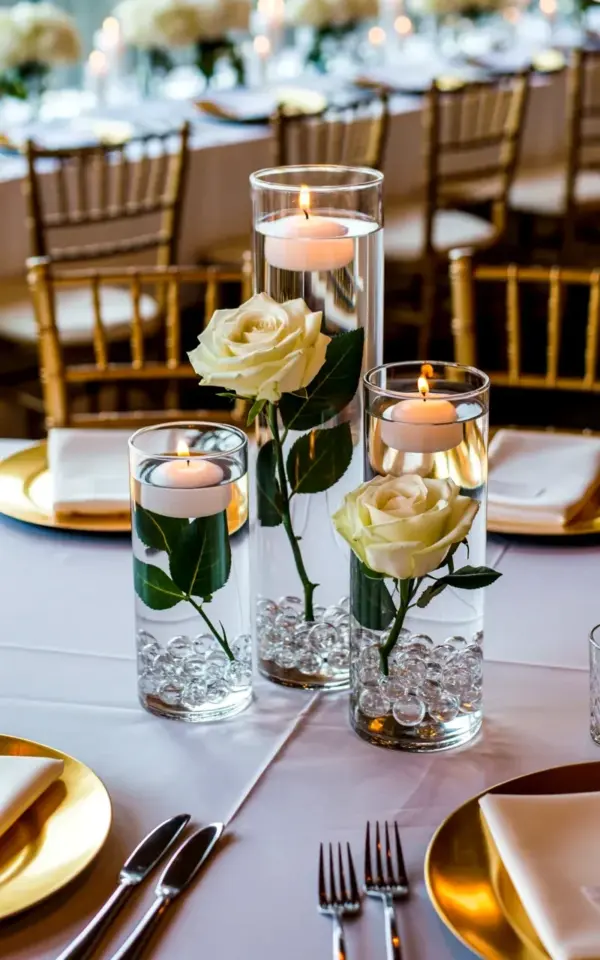
They always post the perfect floating candle centerpiece on Pinterest, but the version I made almost didn’t happen. This weddingtablecenterpiece uses three clear glass cylinder vases at different heights, filled with crystal beads, a single white rose, and a tea light floating on the water. I remember staring at the bare green stems in the grocery store and thinking there was no way this would look formal enough for a reception. I was wrong. The glow through the glass, all warm and wobbling, changed the entire mood of our table.
So here’s my take, written as a common mistakes guide. Trust me, I made every single one of these before I got the before and after right. And honestly, the fix is usually easier than you think.
Mistake #1: Using Vases That Are All The Same Height
The first time I tried this floatingcandlecenterpiece, I grabbed three identical vases from Dollar Tree. They looked like sad little drinking glasses. Nobody wants a reception table that resembles a bathroom shelf.
The photo that made me save this idea used three different heights, arranged in a loose triangle. One short, one medium, one tall. That little visual rhythm keeps the eye moving instead of landing on one flat line. If you have tall vases, cut the rose stems for the short ones. If you have short vases, let the tall one run long. The difference matters more than the exact heights.
Roughly seven, nine, and eleven inches works great for a standard six-foot table. But you can fudge it. Just don’t make them all the same.
Mistake #2: Forgetting To Layer The Inside (The Bead Trick)
Plain water in a clear vase with a rose floating around looks unfinished. Not gonna lie, it looks like you forgot something. Those crystal beads at the bottom aren’t just decoration, they anchor the stem and give the whole thing weight.
Now here’s the thing I learned the hard way. The beads need to be deep enough to hide the stem end, but not so deep that the rose looks like it’s choking. I used about an inch and a half of beads per vase. Some clear, some frosted, nobody cares as long as they catch the light.
If you can’t find crystal beads, aquarium pebbles work. Round glass gems work. Anything with a little shine. But don’t skip this layer. That bead layer is the difference between a centerpiece that looks like an afterthought and one that looks intentional.
- One and a half inches of beads per vase
- Stems cut at a sharp angle under water
- Room temperature water, not ice cold
- Tea lights that are actually designed to float
- Three different vase heights
Mistake #3: Choosing The Wrong Roses (Or The Wrong Condition)
My initial run used a half-open rose with tight outer petals. It never opened. It just sat there looking annoyed for four hours. This whiterosecenterpiece idea depends on a rose that’s already starting to relax.
Look for cream-colored petals that are slightly soft at the edges. Those fully bloomed ones in the elegant inspiration photos? They did not start that way. They were probably bought two days before and left in warm water overnight.
One more thing. Strip the leaves off the lower half of the stem. Dark green leaves floating around the water and poking the glass drive me crazy. Keep only a few leaves near the top. Otherwise the vase looks like a jar of compost.
Mistake #4: Overlooking The Water And Candle Ratio
Floating tea lights are tiny. They need enough water to stay away from the glass bottom, because that glass gets hot fast. I learned this the unpleasant way when a candle cracked my vase right down the middle. The whole centerpiece drained onto a rented tablecloth.
Fill the vase until the water level sits an inch below the rim. That gives the tea light room to drift without sloshing over. And check the candle packaging. Some tea lights are heavier and sink, especially the ones with thick aluminum cups. Buy ones that say “floating” on the box. They’re a different height and shape.
Also, don’t light them all at once. Light them right before guests are seated. You want the soft glow, not a smoky mess halfway through the toast.
Mistake #5: Ignoring The formaltablescape Around It
A centerpiece doesn’t exist alone. Mine looked absolutely lost on my dining room table until I added the white tablecloth, gold-rimmed plates, and silver cutlery. That formaltablescape is what makes the candlelight feel elegant rather than accidental.
Set the table first. Then place the vases in the center, and I mean the dead center. The classic mistake is pushing them to one end to make room for salad plates. Don’t do that. Arrange the three vases in a triangle, leave about three inches between them, and let the table setting frame them.
Even the water in the vases looks better when the plate next to it has a gold rim. I can’t explain that. It just does.
You Already Have Ten Minutes (How To Assemble)
Ok so here’s the before and after. Before: a bare table with rented linens, a stack of napkins, and no focal point. After: three glowing vases that people walk around the long way to avoid disturbing. The assembly takes less time than writing the seating chart.
Cut the rose stems, drop them into the bead-filled vases, fill with room temperature water, and place a floating tea light on top. That’s the whole process. I spent more time deciding which side of the plate the fork goes on.
If you’re doing this for multiple tables, set a production line. One person handles beads, one handles roses, one fills water. Seriously, a twelve-table reception can be done in under an hour with three people and a lot of trays.
The floating candle glow, especially with white roses and those gold accents, is one of the best receptiondecorideas I’ve ever stolen from a photo. Just don’t wait until the morning of the wedding to test it. My first test run involved a cracked vase, a drowned candle, and a very soggy tablecloth.
Why It Works For Formal Receptions (And Everything Else)
I was convinced this was only a black-tie wedding thing. But the same vases looked great on a farm table with brown paper runners and mismatched chairs. The trick is the absence of clutter.
Three vases, one flower each, one candle each. Anyone can pull that off. You don’t need a florist, and you don’t need to spend two hundred dollars per table. The crystal beads are reusable. The vases end up cheaper than a single bouquet.
The white rose does the heavy lifting. It reads as classic and clean, but it doesn’t fight with the plates or the centerpieces on the next table. And when the candles are lit, the petals go translucent at the edges. Hard to beat that.
So if you’ve been staring at a Pinterest board full of elaborate arrangements, try this one. It’s forgiving, it’s cheap, and it saves you from a week of diy stress. Save the photo, skip the mistakes, and light the candles right before dinner.
Leave a Comment